- ▾ ShakeOut Regions ▾
- Alaska
- American Samoa
- Arizona
- British Columbia
- California
- Central U.S. (AL AR IA IL IN KS KY LA MO MS NE OH OK TN)
- CNMI
- Colorado
- Guam
- Hawaii
- Idaho
- Japan
- Montana
- Nevada
- New Mexico
- New Zealand
- NorthEast U.S. (CT MA ME NH NJ NY PA RI VT)
- Oregon
- Puerto Rico
- Quebec & Eastern Ontario
- SouthEast U.S. (DC DE FL GA MD NC SC VA WV)
- Texas
- Upper MidWest U.S. (MI MN ND SD WI)
- U.S. Virgin Islands
- Utah
- Washington State
- Wyoming
- Yukon
- Other Countries


Why Should You Participate?
Many areas of the globe are prone to earthquakes (see links below) You could be anywhere when an earthquake strikes: at home, at work, at school or even on vacation. Are you prepared to survive and to recover quickly?
Great ShakeOut earthquake drills are an opportunity to practice how to be safer during earthquakes: "Drop, Cover and Hold On." ShakeOut also has been organized to encourage you, your community, your school, or your organization to update emergency plans and supplies, and to secure your space in order to prevent damage and injuries.
Benefits
Register today so that you or your organization will:
- Be counted in the largest-ever earthquake drill in the world!
- Be listed with other participants in your area (Optional)
- Be an example that motivates others to participate & prepare
- Be updated with ShakeOut news and preparedness tips
- Have peace of mind that you, your family, your co-workers and millions of others will be better prepared to survive and recover quickly from our next big earthquake!




EARTHQUAKE HAZARDS
Hazard Information for Official ShakeOut Regions:
Select a region and click "go" to be directed to the region's
"Why Participate?" page.
Information will be added here soon. For now please visit these webpages:
Earthquakes information by State (United States Geological Survey)
Earthquakes information by Country/Region (United States Geological Survey)
Why Drop, Cover, and Hold On?
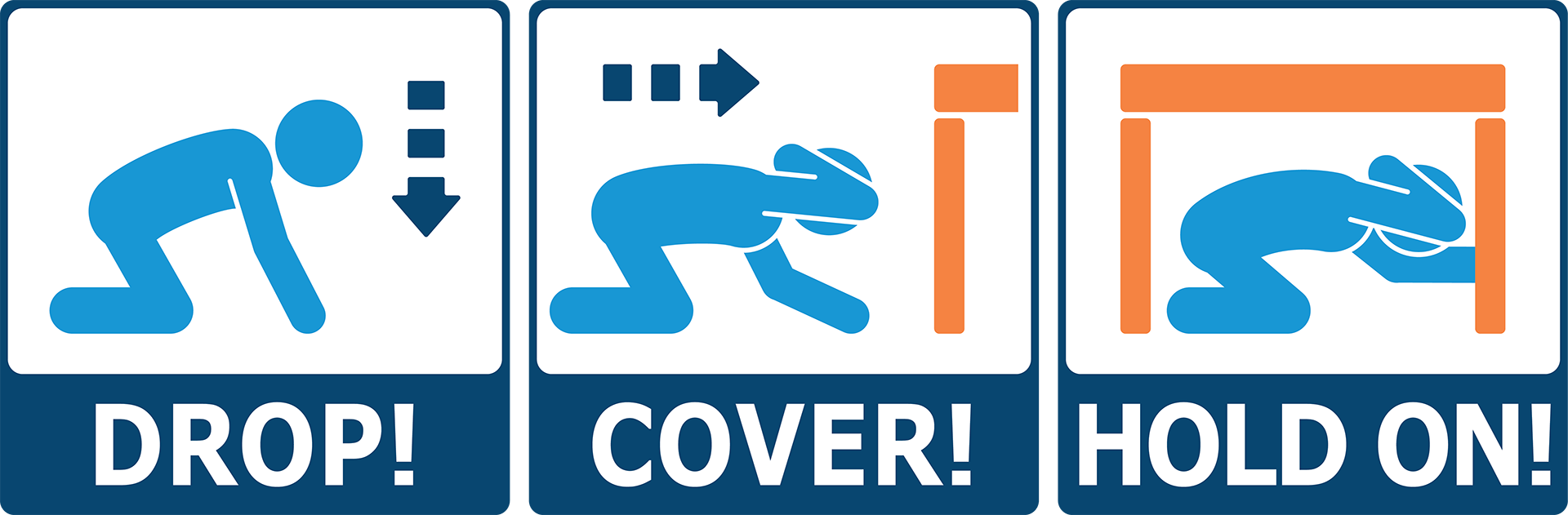
Why is it important to do a Drop, Cover, and Hold On drill? To react quickly you must practice often. You may only have seconds to protect yourself in an earthquake, before strong shaking knocks you down--or drops something on you. Practicing helps you be ready to respond.
- If you are inside a building, move no more than a few steps, then Drop, Cover and Hold On:
- DROP to the ground (before the earthquake drops you!),
- Take COVER by getting under a sturdy desk or table, and
- HOLD ON to it until the shaking stops.
- If you are outdoors when the shaking starts, you should find a clear spot away from buildings, trees, streetlights, and power lines, then Drop, Cover and Hold On. Stay there until the shaking stops.
- If you are driving, pull over to a clear location, stop and stay there with your seatbelt fastened until the shaking stops. Once the shaking stops, proceed with caution and avoid bridges or ramps that might have been damaged.
Ground shaking during an earthquake is seldom the cause of injury. Most earthquake-related injuries and deaths are caused by collapsing walls and roofs, flying glass and falling objects. It is extremely important for a person to move as little as possible to reach the place of safety he or she has identified because most injuries occur when people try to move more than a short distance during the shaking.
Look around you now, before an earthquake. Identify safe places such as under a sturdy piece of furniture or against an interior wall in your home, office or school so that when the shaking starts you can respond quickly. An immediate response to move to the safe place can save lives. And that safe place should be within a few steps to avoid injury from flying debris.
Further information: